Tuesday, May 3, 2022

Originally published September 27, 2020 on Medium

The Era of Democracy Has Closed.

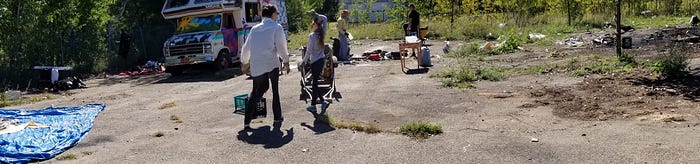
Some folks helping to clean up a homeless camp. copyright Stephen Marshall.


Hardin’s Tragedy

Originally published on Medium on October 23, 2020

Recently I read an article by Matto Mildenberger, writing in Scientific American, about Tragedy of the Commons. Inspired, I read Hardin’s commentary for myself.


Sharing equals security


date of original publication April 6, 2017. Posted to Vermont Digger. 

The Trump era is not of Trump's making. The financial stress, promised to us as conservatives, finally in charge of the purse strings after fighting the New Deal for 80 years, rewrite the social policy priorities of our country, will destroy many of the gains against poverty we have made, and leave millions of Americans and 100,000 Vermonters in a Social-Darwinist gutter. I can't bring myself to imagine the picture that results.

Of course we enter what is for us a new world. Where we are no longer Post New Deal. We are now Old Deal. That very old deal. Where privilege begets privilege and all of the gains, which have been made to bring people out of poverty and improve the health of every person, are under threat. Where democracy, which made the elites subject to law and the will of the people, of central concern to those who wield power, is at risk. And because climate change can reset the entire course of life on Earth, and what we choose will determine how that unfolds, the future of humanity and life is in play, and this is a civilizational moment. Do not take this choice lightly.

As we face the impacts of the “conservative” vision in our individual spheres of interest, I hope that everyone will speak loudly and as one voice, that the problem is not that there isn't enough money, that the problem is not that our group deserves money and the other group does not, but that the problem is that those of privilege, those who are in control of the wealth, are unwilling to share it. There is plenty of wealth to do what we need to, but the people who control the wealth also control the people who write the laws and govern the people. We must set them straight. They are not entitled to hoard the wealth that the community produces.

The idea that wealth is created through investment is not wrong. But the work is not done by the investor. The entire community, working as an enterprise, including the law, the labor, the natural legacy of the community, and the social fabric, is needed, and that the law is written so that the investors reap the rewards and are able to accumulate that wealth for personal hoards, while others live with too little to meet their needs, is a mistake in the structure of the economy. Such a harvest of the wealth by the wealthy undermines the vigor of that economic engine, and damages the lives that are its purpose. Wealth must be circulated, and the needs of the people met, or the society will fall ill, decay, and destroy itself. We are witness to this process now.

Americans seem to regard the acquisition of wealth as the best way to create personal security, and the right to get wealthy as an intrinsic right of self-care. It is the core of the American Dream, and there are so many flaws in this logic

1) Wealth in a silo is inherently insecure. Every person, no matter how wealthy, depends on the health and well-being of everyone else and the community to be safe and comfortable. If you do not share, you are a target. You resort to guns, increase oppression, become callous to the loss of life, witness the destruction of our planet and discover the meaninglessness of your own life.

2) Wealth in a silo ignores the eternal human strategy of sharing to ensure community well-being. People instinctively reject selfishness on the part of others. If you have nuts, meat, land or money, you are expected to share. Sharing creates long-term stability and security for everyone, and hoarding (including wealth) is damaging to the community. Imagine I have caught game and I hoard it. Before I can eat it, it rots. Others have not enjoyed the benefit of my catch, nor have I.

3) The most secure and stable societies, in which everyone gets their needs met, value sharing. Wealth is not required to have a rich and meaningful life when the entire community is healthy. When the social fabric is healthy, there is no poverty no matter how little wealth there is.

4) Wealth disparity in itself is a signal of decay. (See "The Spirit Level" by Wilkinson and Picket.) Social, political and economic sustainability is reduced by increasing wealth disparity. We can improve our chances of social and cultural longevity and sustainability by creating institutions which enforce the circulation of wealth from the wealthy back to the poor and marginal.

Since the normal functioning of the economy transfers wealth from the poor and marginal to the wealthy, measures that transfer the wealth back to the underprivileged merely balances the system. The question we are compelled to ask is whether we will allow those who are privileged and control the wealth to continue to increase their wealth forever, leaving the rest of us to become poorer and poorer, more and more desperate, and the society ever more divided and combustible, or we will decide that the well-being of the community and its members is important, that living in one community in which everyone is valued is important, and find ways to capture the wealth of the society to correct its ills.

The change we must make in our thinking is from "wealth=security" to "sharing=security." When we achieve illusory security through wealth, we divide our fates from the fates of our fellows, and make the world less stable. When we decide that the entire society must be secure and healthy to promote personal security and wellness, then sharing is the logical course of action. We must all be asking, “How can we make the community and its members healthier and more secure?” And be prepared to support those strategies with the wealth of our communities.


A silent thought

May 3, 2022

I have neglected my blog because life whirls around me and my efforts fly centrifugally away. I write and my words are lodged in a notebook, a letter, a journal, any where but without a thought of this repository. 

Perhaps I will change this. Perhaps I will fly another year before I land on this page again. Perhaps I will devote my time to a website or academic papers. But Dispolemic is the home of my writing. Perhaps I will try to bring unkeyed writing to the electronic page. 

I am going to take a chance and deposit a coin of my time from five years ago. Let's see if the silent audience even notices. 


Saturday, November 6, 2021

Responding To An Advocate of Municipalism

thank you for the synopsis. I wondered why you were so eager to engage me in conversation, and your essay does explain your motivation. I suspect that something like this provides the best strategy for freedom and agency against the abuses of state police power and the interests of capital accumulation, and there are many of us searching for better, more effective ways to rebalance the equation.

I thought you might be interested in this book review, which my browser offered for recreational reading. (Firefox Pocket, if you're familiar with it.)

It offers a sense of the fluidity of the project of maximizing freedom and agency with least harm. I don't think Municipalism is wrong, but sometimes the route to a goal isn't a straight line. I've engaged with many idealistic and ideological struggles, and have never had the satisfaction of persuading anyone at scale. Mostly I found myself in an echo-chamber, or completely alone. Consider the travails of Lao-Tzu, who tried to impart his philosophy to war lords across China (he wanted them to take care of their peoples), only to die without having persuaded even one. The model of change I follow is more organic. Ever keeping the largest vision in mind - maximum freedom with least harm - I engage the project that interests me, and keeps me engaged in the community, and by the small moments I am able to produce, move the world toward justice and kindness.

I suspect this is not helpful to you, but I will develop one more idea. When I was a teenager, I encountered the Born Again Christian movement, and later the Jehovah's Witnesses, who with many others, wanted to deliver paradise, if only everyone would believe. My answer to them was "You'll never persuade everyone, so why would I join you?"

But humanity is guided by that Pole star, equality. We are not seeking unfettered impulsiveness, we want that balance of freedom and accountability which fosters life. I assume you are also guided by that pole-star. So there may be a formula and there may be many formulas. The way we get there is by experimenting, and it's mostly a contingent process, I think they call it heuristic, where the agent of change doesn't make the change but (a-la Lao Tzu) tries to shape the change that finds them.

I believe, feel, that we are doing that here in our mutual aid society. We are collectively working toward something like what you are proposing, but you won't get everyone to make the leap of faith before they have arrived there on their own. I have worked as an advocate for the homeless for years, but my greatest impact has come after the emergence of the mutual aid group, completely without my making any effort to create it. It happened, and it has strengthened my voice.

Don't go big, seek change in the margin where your efforts will affect how people behave. Test your ideas by advancing them and seeing how people respond to them. Look for ideas that are appealing, and develop them. You may find that the growth is not in others, but in yourself.

I hope this explains why I have not been responsive to your appeal. I apologize for any disappointment I have imparted. I encourage you to continue the development of your ideas, but remember to ask yourself, "How does this help others solve problems they are trying to solve, in this moment?"

Tuesday, February 9, 2021

The Funnel of the Constitution of Knowledge rejects the Conservative vision


Mr. Rauch is brilliant and well published. Here  are links to three websites which have printed this article. 

https://www.jonathanrauch.com/jrauch_articles/2018/09/the-constitution-of-knowledge.html

https://www.brookings.edu/book/the-constitution-of-knowledge

https://nationalaffairs.com/publications/detail/the-constitution-of-knowledge

and here is a link to the book by the same name. 

https://www.amazon.com/Constitution-Knowledge-Jonathan-Rauch/dp/0815738862

I place in the public record my response: 

Dear Mr. Rauch,

I read your article, the Constitution of Knowledge with the deep satisfaction of finding the sublime truth of our current cultural moment, because it explained so much, and portends so much. Alas this moment was marred when you spun on your rhetoric to claim that, somehow, it is unjust for conservatives to be excluded from academe, because, you say, they must be part of the engine of the constitution of knowledge.

I’ll grant you that to some extent intolerance is being shown, by students and by faculty, when conservatives are excluded from campuses. I have seen it, and attended meetings where the protests were organized. The young people who want to deny to conservative speakers the right to speak are angry. We might ask why they are so angry, for what it is that they petition. And listen.  

Because you just finished explaining to us that the college campus is the epicenter of the institutions that engage in the vetting of knowledge and the constitution of knowledge. It is there that critical thinking and the methods of legitimate investigation are taught. Have you asked yourself whether the engine of the production of truth has not, perhaps, rejected the conservative ethos, for reason? This would of course be uncomfortable for you, as a conservative, but in the interest of truth, is this not a legitimate question?  

This indeed would seem to be the hinge on which your complaint turns: are the reasons for excluding conservatives from college campuses legitimate (that the conservative vision fails to provide an inclusive path toward truth, right action, a safe and healthy Earth), or are the reasons spurious (that people are viscerally repulsed by the affect and effects of conservative speakers and their policies, or they are engaged in propagandistic control of speech)? I would grant you that being socially ostracized for conservative perspectives, as some students claim, exists and is repugnant, if you will grant to me that conservatives, by espousing the prerogatives of wealth and the rights of power, and American exceptionalism, do all the heavy lifting of alienating the students and intellectuals who are engaged in the constitution of knowledge. Because they see the pursuit of wealth power and national exceptionalism as a death sentence for the planet. They have a right to exclude conservatives under the principles you espouse in your article. The funnel of knowledge is rejecting the conservative vision for the future.

I am old enough to have watched generations of conservative political leaders and intellectuals espouse property over people, wealth over environment, xenophobia and racism over a shared membership in a democracy, dance with fancy logic and slight of tongue, or outright lies, to preserve the rights of oil companies and coal companies to work workers in unsafe environments, pollute and add CO2 to the atmosphere, threaten precious wilderness with logging and oil development, build industry in the poor and the colored and the native lands, and dodge responsibility for any of the effects. So while I have an emotional and intellectual interest in sharing the stage with (I am an inclusivist) anyone who respects the imperative of inclusiveness, my sympathies are with those who would exclude those who argue for the privileges of power and wealth. I am fed up with the crocodile tears from the right. The Conservative movement has argued itself off the stage. 

The right knows its arguments are not winning with the American people, despite 75 years of think tanks, organizing, publishing, propaganda, and political victories. It knows that in a fair election with universal enfranchisement, it cannot win. It knows that without the army formed with the propaganda of Fox news, Rush Limbaugh and NewsMax, it would not have a constituency at all. It knows that as the boomer generation dies off, so also will conservative vision for the future. This complaint of conservatives being kept off university grounds sounds to me like so much bellyaching over losing control of the narrative. Sure conservatives want to be part of the conversation, but that isn’t a privilege granted to everyone who enters the funnel of knowledge. It would be such a joy and such  an amazing gesture if the conservative movement were to be honest with us and itself: it has lots of brainpower, lots of logic, and lots of echoes, with which to convince itself that it is correct, but it is out of step with the best interests of humanity and the planet, and the young people professionals and intellectuals of the engine of the constitution of knowledge know this. And that is why conservatives find themselves poorly represented on campus, and in the media – except for those that it builds – where it produces not knowledge, but religion, conspiracy and propaganda. Thus it is excluded from campus. Fair is fair. 

I respect the moderation you seem to bring to your essays, the arguments of moderation you bring to the debate. But am I wrong you call yourself a conservative? No? Then you align yourself with many of the worst actors in American history. I suggest you change your label, and cease to defend this one.

You might have noted that despite a certain facility with words, I am really a nobody. Therefore I can say what I say, because I look up from below. 

Thursday, December 31, 2020

Economic Policies to Address a Downturn

I am subscribed to Research Gate, a web-based self-publication journal. Occasionally I visit and today I got engaged in a thread (https://www.researchgate.net/post/What_socio-economic_policy_is_appropriate_for_the_period_of_slowdown_in_economic_growth) that asked 

What socio-economic policy is appropriate for the period of slowdown in economic growth? (Dariusz Prokopowicz, Cardinal Stefan Wyszynski University in Warsaw)

In a comment stream with 506 responses, this one by Martha Pantoja is representative: 
In a period of economic slowdown, expansionary monetary and fiscal policies should be applied to boost public and private spending and consumption, which in turn stimulates investment.

I do not want to engage the minutia of these macro-economic policy solutions. The argument is inadequate on its face. 

While macro policies employed by governments and institutions must be correctly adjusted (the topic of so many comments here), we must take heed of the premise which seems to pervade these analyses. There is very little discussion of how to support individuals, families and communities to utilize these expansionary policies, or indeed how to survive during the downturn, or how to structure the economy, wealth distribution, or resource accessibility. They seem all to suppose that economic growth cures all ills, and that the invisible hand of the market place automatically distributes resources where they are needed. 

Since growth is cyclical and constrained by the bio-physical limits of the Earth, there must be downturns and periods during which macro policies have failed and other systems must be in place. Since resources follow wealth, they in fact do not automatically allocate according to need, and the economy must be structured to improve access to resources at all times, including especially non-peak low-growth, non-growth periods. 

The idea that growth must be fostered because in growth there is more wealth to be distributed would be valid if in fact the poor were getting richer and the richer were getting poorer. However, even if the bottom incomes are rising some bit, most increases in wealth are allocated to those who are privileged to already control some wealth, and the flow of wealth increases most with the amount of wealth already in possession (due to exponential return on non-encumbered wealth: poor people cannot afford to invest in growth securities and benefit from exponential growth, but those who are already wealthy can). Therefore the remedy of fiscal and monetary stimulus is inadequate. The economy must in the first place be engineered to ensure that money flows to those without market leverage or high demand skills. The goal is not to make everyone rich, but to stabilize and ensure the distribution of goods that are necessary for health and opportunity. 

The concept of Carrying Capacity predicts that, in the absence of planning and care, there must be pain as populations increase to the margin of resource availability. This pain is universally experienced by the poor, allowing the already rich and thriving to consume and reduce the resources that could be allocated to the poor, without suffering any consequences. This is highly ironic because the response of all humans to insecurity is to have more children, not fewer (contrary to Malthus; consistent with the demographic transition), resulting in more suffering. Since insecurity, and suffering, are concentrated among the poor, extremes of population growth are also concentrated there. However, strategies such as education and access to contraception are very effective ways to help poor people escape the cycle of suffering that results from having too many children, and focus on economic well being. However these strategies require government and institutional action. 

The primary focus of policy makers therefore must be to promote not growth but stability of access to resources. Another view of the stability of access to resources is "justice". In fact these are distributive policies, which seek to "bake in" fairness, to obviate the ages-old pattern of the rich harvesting the bounty of the land while the poor must do the work, without getting the benefit. Growth does not inherently increase access to resources, and therefore policies promoting growth do not either. Policies that promote justice, the distribution of resources, and the security and  stability of access to resources are the proper policies to alleviate the effects of downturns.


Sunday, October 18, 2020

Burlington on the Cusp of Trump’s (hoped for ) Defeat


My community development textbook identifies three configurations of the political culture which define the kind of development which is possible.

- No-Growth, led by a cohort of financial interests, who prefer to maintain the status quo. It holds the power and operates to keep people and groups with needs out of the political decision making. This arrangement conspires to keep participation low.

- Pro-Growth, led by a cohort of financial interests, primarily the rentier class, who profit from increasing pressure on the supply of real estate to raise rents and increase the extent of rental properties available for new rentals. Since you must own property to have the cash flow to buy property, this model tends to enrich a few even as the rest of the community is ground into low income employment and poverty. It holds the power and operates to keep people and groups with needs out of the political decision making. This arrangement conspires to keep participation low.

- Smart Development, led by no one and everyone, it depends on the culture of the community that insists on inclusion and participation. Decisions are made in public meetings and infused with listening. There aren't any closed door meetings, and groups with a grievance are heard and included. This arrangement shares the power of community decision making, and operates to increase participation.

This ideal vision is enacted in many American cities, along with the corrupt forms listed first above, and is, I would argue, what we are striving for. But we must keep our eyes on the ball. Since we have a distinctly not machine Council at this moment, Burlington is not solidly in the pro-growth camp, but the mayor is clearly a growth oriented administrator, using the power of his office to make deals and promote the profit making interests of the business class, bulldozing any resistance and shutting out voices of contrary interests. And we must watch our councilors for slippage.

Each of these systems possesses its own homeostatic equilibrium, that it is difficult to escape from. Burlington, prior to Mayor Sanders, was a machine city. Sanders' election instituted some changes that moved Burlington toward the Smart Development vision, but the shift wasn't complete. To complete that shift is our higher mission.

Although I do worry about a Trump coup, at the root of our crisis of civility and radical anger, marginalization of some groups and enhancement of privilege for others, is the failure of the American system to include everyone - including people whose imaginations lean toward fascist, socialist or just criminal - in its prosperity in times thus due, and the costs in times of loss, in short, to promote a vision of a shared destiny. I don't trust the Dems to do the right thing, but our interests do not align with taking power and effecting certain policies at the expense of others. Our interests align with those who share our vision of an inclusive culture that engages everyone, brings everyone into the conversation and promotes solutions which maximizes well-being, opportunity, diversity and participation across all fields of expression. We need to support political leaders who understand that vision, are willing to take chances to increase the franchise of participation, who are motivated by a vision of a community where everyone feels they can find a safe and legal way to make a living and lead the life they want to. The Dems will fail us, the Progs will fail us, but individuals will step forward and no matter their party, we must advance them and hold them to the promise of our vision.

One of the failures of previous Progressive administrations was that they fell into the no-growth mode. They built very little housing, and allowed voices of resistance to take priority. A healthy city doesn't exclude business interests and rentiers from its decisions, secondly because this would inspire sabotage, but firstly because it would violate the principle of inclusion. A healthy city allows organic growth without prioritizing growth. A healthy city does not call for stasis, it promotes thoughtful change. Until we are able to institute property-ownership-in-common, and set up a coop-model and employee-ownership model of every different kind of business, so that private profit making isn't the primary model of economic activity, we'll need to work with these groups - the vision of an inclusive city simply does not tolerate exclusion of them. The key difference is that an inclusive city is one in which private wealth accumulation is not the reason and cause of all decisions. It is simply one of the normal features of living, which occurs in many ways. We need to normalize business activity as not an evil, but as an activity that is sometimes conducted in evil ways, and whose evil ways must be ended. What these are then become a matter of agreement in an inclusive community. We must promote the marketplace of ideas, and let the best ideas surface, always with our eye on the prize - a city that is peaceful because the people are happy and able to live full lives as members of a community that loves them, which they are able to love in return.


Wednesday, October 14, 2020

My Statement To Charter Change Committee, City of Burlington, Vt.


Every status - banker, landlord, tenant, advocate, lawyer, owner, renter, homeless - is a category we engineer into our laws. We can change those laws to ensure that everyone is protected equally and to maximum well-being. By requiring a reason to evict, the law would only be telling property owners "you can't do this for emotional reasons (you don't get along with your tenant), or on a whim. If you must have a substantial reason, your rental business will not be harmed, your business will be more stable, the community your properties are in will be more stable, and the lives of your tenants will improve." Moreover, such a requirement reminds us that being a property owner isn't just to benefit you - you are renting to human beings who need the services you are offering, and once you do rent to them, you must afford them the justice of never evicting them without them having already done you harm. To demand that dignity is not such a huge ask, as these are members of your community. To require a just cause for an eviction is simply to give the tenant the dignity of calling their rental their home.
.

Sunday, September 27, 2020

The Era of Democracy Has Closed. Long Live Democracy.


Democracy is the luxury of elites who have plenty to share between them, who feel they are safe to share their power. Then, who is "elite" in this democracy can be defined to include non-property owners, non-men, non-whites, non-cis-gender, the non-wealthy, even non-nationals! Who is elite, and for whom democracy operates, can be defined to be an entire nation, as long as there is enough to share, and as long as everybody is ok with sharing. Correction: Capitalist Democracy is a luxury of elites. 

Unfortunately, as the Non-s proliferate and demand shares of the fruits of a democratic society, some folks freak out. Their freedom, wealth and privilege having been premised on the oppression of some of these Non-s, and they get less willing to share. They see all these OTHERS, all these Non-s, gathering around, and they see the water rising around them, in many cases very literally, while others escape in their yachts, sometimes literally, and they see the value of their wages going down, and their health care getting too expensive to use, they’re losing their homes and jobs and they’re not better off than their parents, and the for-profit system is stripping all the value out of their paychecks and they’re feeling super-stressed and when they look for a reason for this stress, the words of a demagogue are soothing. Don’t practice humility, don’t be vulnerable, don’t ready yourself to take responsibility for unspeakable horrors, don’t ask “What can I do better?” Blame everyone else. Blame the OTHER. Blame the Non-s. Blame for your embedded guilt for the acts of genocide and slavery of your ancestors, blame for your embedded guilt for hoarded wealth, everyone else. But don’t blame the elites. Don’t blame them with the bullhorn. Don’t blame them with the checkbooks. Don’t blame them who can do something about it. They have what we want. And why would that include democracy for everyone else?

And while some people freak out because the Non-s are coming for their share, the Non-s might have some pent up rage, and hate at them who ain’t willing to share. So there might be some tension in the air. And danger of riots. 

And if we get Donald Trump for another term, it may be a very long term, maybe the terminal term, not just because he has so cleverly crafted his rhetoric and used his powers of manipulation, but because the conditions under which democracy, and sharing, are possible, are collapsing from our self-serving neglect of our democracy.

How is it that democratically controlled town boards cannot set building standards for the residents of their towns, so that when fires rip through, those houses will not be destroyed? If this is democracy, democracy is about to kill itself on the altar of personal freedom to choose to die in an inferno. If a scientific fact cannot be accepted by the democratically elected Congress, and that Congress cannot write legislation to fight global warming, what good is democracy? Correction: capitalist democracy.

Because democracy doesn’t work when you’re selfish, when you’re only asking “Where’s mine?”.

Meanwhile, autocratic China is able to declare — credibly — that it will be net carbon zero by 2060. Meanwhile, research I have read informs China policy makers on how to preserve ecosystem services by reducing sprawl. I hate the genocidal aspect of the Chinese government, I hate their brutal methods of restraining population growth, but it may be the autocratic Chinese government that saves most of the people of the capitalist, individualist west from their own self-annihilation. But only if the Chinese succeed soon enough.

How to avoid both of these possibilities? How do we avoid both democratic-hedonistic self annihilation, and autocratic assimilation? We have to do things I don’t count on us to do. We have to share: political power, wealth, food, opportunity, the benefits of trust and caring. Radical equality. The rich have to give their money away, have to unwind the privileges rigged into the system, to make the system work for everybody. They have to pay very heavy taxes, so we can have health care, affordable housing, The best child care and education for every child in America and the World. We have to live by the maxim “I can only be safe if I am safe for you.” We have to stop hating on each other. We have to listen to those who oppose us, who want to hurt us. This lesson from the prophet Jesus redounds brilliantly to this moment. We have to vote for leaders who will act in the best interest of the country and the world, we have to ask ourselves “Which candidate is the best for everybody?”. 

We have to give up on our own personal importance. We have to re-imagine our personal value as the value we derive from the happiness and survival of everyone we know — including those we used to hate on. Please stop hating. Time is running out. When you are staring into your own death, don’t your priorities get reset? When you are staring into the death of your planet, could it be time to reset how we, as humans, do things?

Because every other path leads to Global Flood and Global Inferno, leads to the planet purging us, and all of life as we know it, in a great fever.

Pop-quiz! List everyone you know. Include yourself. Imagine a car careening at this huddled group, and one person could stop that car by standing in its path. Would you step forward?


Tuesday, September 8, 2020

Stephen Marshall, Who am I?


Assignment for CDAE 351 

Who I am, right now, is entangled with the volume and complexity of the work we are expected to do. I am wondering whether this was a good idea after all. But I will fight, I will muster any energy I can find, to do the work.

I grew up in a post-WWII development neighborhood in Yonkers New York, that was mysteriously free of black or colored folks (whom I met on the bus to the YMCA summer camp), which was safe and gave the illusion that somehow the world would keep going as it was. When I learned about the collapse of the Roman Empire, and the idea of the collapse of American democracy formed in my mind, I thought it was inevitable, given enough time, but not in my lifetime. Not understanding the injustice and inequality supporting the world that I lived in, or the depravity of the human soul, the promise of American democracy seemed perfect. I would never see its end. There was genocide and racism, but placed in my consciousness as side shows, that I could safely ignore.

But then there was the Vietnam War ("American War" to the Vietnamese), there was poisoning of the planet, overuse of resources, there was the Civil Rights movement, and invisible to me, the crass pursuit of personal wealth at the expense the lives and health of other people. There was the rise of the xenophobic, demagogic, racist politics of the Republican party under Newt Gingrich and his successors, then the continuing genocide and betrayal of the native Americans, and police brutality to support institutionalized racism, then global warming, and then there was Donald J. Trump. Apparently the liberal world order is fragile, apparently there are many people who feel they are getting shafted and that the liberal world order is to blame. Apparently the collapse of American democracy is possible, and it may occur within my lifetime. Apparently the "liberal world order" was a front for privilege and an excuse for doing nothing to help other people lift themselves out of poverty.

I imagine a world in which WE, humanity, turns toward helping each other. In which WE decide to arrange the economy and our relationship to the planet to provide means of survival for every person, and minimize harm to the planet. "I can only be safe if I make the world safe for you." In which every day our leaders are driven by the question, "How can I make the planet and my community safer, more healthy, more verdant and sustainable, today?"

Human beings have an instinct to address danger: the tribalistic impulse. When in danger, gather your people around you and put up defenses. A skilled manipulator, a proponent of the inequality and injustice that caused that danger, can take that fear and use it to destroy the last remnants of your impulse to share the American promise, can use it to destroy the hope of generosity and cooperation promised by the hypocritical liberal world order.

There was always inequality and it never mattered who was in charge, because the laws are always written to protect the wealth of the wealthy and drive the middle class into poverty. Democrats used a hypocritical allegiance to African Americans, poor people, and labor, to systematically hold onto their privilege, they used the promise of "growth" to defer justice, just like the Republicans. Republicans, without nuance or shame, disavowed any policy that would reduce the capacity of business to concentrate wealth for the few, and motivated their electoral base with the illusory notion of "freedom" and the right to get wealthy. By declaring for the right of each individual to act in their own interest, the Republicans have given Americans no opportunity for collective action except that which they, the Republican elites, would find useful. The Republicans have set up Americans for only one form of unity: the unity of war against other Americans.

Everyone is justified to be angry. The elites at universities, in government, in corporate boardrooms, have systematically deprived us all of a sustainable, just world, in service to their personal aggrandizement. Democracy in America was a hoax, just as the promise that "growth" will lift everyone out of poverty is a hoax. As a leftie from the '60's, I have been waiting a long time for the revolution. Revolutions are ugly and can't produce justice or sustainability. But justice wasn't, isn't, going to happen on the path we are on. Somehow, WE have not learned how to manage our affairs to make the world safe for everyone.

In ecological economics, we talk about cooperation and how to achieve it. As if the world is full of individualistic, self-fulfilling "rational actors" who don't know how to cooperate. But that is wrong. Those "individuals" are forming into a massive human action. We better get our heads out of our butts. Our current theory does not explain this.

So you can see what my interests are in a broad sense. I have been trying to understand what is worth fighting for, for my entire life. Science, anthropology, history, have informed my quest. At its root is the question, "How can I explain everything I am observing so that these beliefs and actions make sense relative to each other?" So my explanation does not depend upon someone else being wrong or the demon in my universe? So that we all emerge with a logical and purposeful intent, even if our concepts of the universe are in conflict with each other?

I read Paul Collinveux's Introduction to Ecology in 1988, and became fascinated by the r-K description of population growth. This dynamic, the variable strategies of rate of growth or sustainable maintenance, I thought explained a lot of human behavior. Also in my bundle of interests is the problem of Carrying Capacity. (Although I am an avowed liberal, the knowledge I propose to create could be used to justify genocide. But to me, it demands a just world, which makes conscious choices, allocates resources fairly.) This knowledge would help us to bring humanity into balance with the planet, could not operate without justice. That is what I care about.


"Natural Sciences and Social Sciences", For Graduate class Research Methods

The distinction seems so obvious I'm not sure I have anything to add. Science is a method of investigation. It puts evidence and rationality ahead of instinct and emotion. Science declares that there is a universe that is real and potent apart from the desires or needs of any human. Socio-religious knowledge puts human needs and desires at its center. Science recognizes that the universe is knowable but not perfectly knowable. Socio-religious knowledge expects the universe to be knowable and seeks to find a moral order that is absolute. Science posits that we can know what is real and true, if we are willing to observe, take evidence, and form our models from these observations and this evidence, if we are willing to let ourselves be wrong. Socio-religious models depend on the need of humans for explanations where the only evidence is contingent, emotional and instinctive, and since that knowledge is created under threat of not surviving, it cannot be wrong.

The greatest distinction is between socio-religious reasoning and scientific reasoning. Religious ideas are always produced as an answer to the contradictions found between the existing vision and the current circumstances (Karen Armstrong, A history of God, 1993). Scientific ideas are produced to address contradictions in evidence. So the critical difference is that while all reasoning is driven by the quest to explain human experience, pain, death, birth, creation and loss, scientific reasoning is limited to using models built from evidence that can be observed by any observer. Many, probably most, people can't step aside from the evidence of intuition and emotion, and their knowledge is cultural. It promotes survival. (When it stops explaining, when survival cannot be secured through it, its holders will become more and more erratic and desperate.) The activity of Science is engaged without the certainty that it will be useful or consistent with prior knowledge.

The paradigmic natural science is physics and the earliest employers of the Scientific method were studying the physical world. Copernicus, Galilei, and DeVinci, and before them Islamic scholars and the Greeks of classic Athens, are exemplars of this method, who studied the physical world. The success of the method of observation (such an astounding privilege to study the world without expecting your knowledge to have immediate utility!) set the pattern for later investigators, including biologists, medical practitioners, and social scientists.

Social scientists are people who study the person and processes of the same subject that would create socio-religious knowledge. They reflect on questions held by all of their subjects, but the evidence they use must be empirical, based on repeatable observations. They investigate a universe, human relationships, structures, arrangements, cultures, institutions, that are amorphous and changing, and their results could threaten someone's access to wealth. They can never create a unified and final theory of all things social, in contrast to physicists, who can hope for a near approximation of a perfect model. They hope to provide some insight that will help reduce the misery that people create for each other, but the evidence of the social scientist, carefully gathered through methods that seek to eliminate the bias of emotions and culture, are not understood by the majority of people who are trying to survive with their wits and culture. All of the dangers the scientific method overcomes pushes back against the efforts of the social scientist. Thus anti-vaxers and Q-anonymous.

The State of Vermont, and the people of the state, fit the pattern of the liberal vision: a free press, secure and popularly accessible ballots, use of data to make decisions, transparency wherever possible in government, and the commitment of its leaders to that liberal vision. Social Scientists are welcome and esteemed here. The elite conspiracy to hoard wealth exists, but it is less prominent. There are good people in government and our communities who protect the liberal traditions of openess, democracy, public trust, and a commonwealth. Here, the evidence of the Social Scientist is welcome, even if they do rely on a socio-religious construct that esteems them.


Saturday, July 18, 2020

Burlington Mayor Solves Homeless Camp Problem by bulldozing it under pretense of building a shelter.


On Tuesday I learned of a plan to build the low barrier shelter in the Sears Lane campground. Later in the day, Jay Diaz of the ACLU sent a photo of a poster announcing the meeting in the Lakeside Commons on Wednesday evening.On Friday we learned just how far the planning had advanced, behind City Hall doors.
The original poster for the meeting announced that it would be a “Discussion about what is happening on Sears Lane and a vision for the future that is both compassionate for people in need of help and for neighbors who expect civil order and laws to be respected.”Demagogic language if ever there was.
If you are familiar with the Sears Lane Camp Parking lot, you will know there are several residents with trailers, campers and lots of stuff. The project calls for about 26 steel storage containers, which have been converted into housing and other facilities, to be placed in the lot. I have not seen a plan to show where those units would be, or whether they would displace the residents who are there now. But on Friday, July 17, engineers from a construction company visited the site and told residents that the plan was to bulldoze the entire site, wooded portion and parking lot. End of Sears Lane Camp.
Whatever the word “discussion” might have implied, there wasn’t any. Joan Shannon introduced the topic, and introduced Kevin Pounds, director of ANEW Place, who described for the audience the Low Barrier Shelter that has been proposed for the Sears Lane camp parking lot. Apparently the solution was in hand even before hearing the concerns of the area residents. Members of the audience shouted out their complaints as the presentation went on, and it became evident that the purpose of the meeting was to introduce a development project as a solution to the issues the community was experiencing, not to listen or discuss. When the Mayor showed up, Councilor Shannon yielded the mike to him and he also pitched the project. When he was ready for questions, I raised my hand.
I rose to speak and took the mike. I observed that Councilor Shannon and the Mayor had conflated the solutions the community needed with the development project the Mayor has in mind, entirely bypassing more obvious solutions. Instead of talking with the community about creating policies to address their issues (security, trash, xenophobia), the mayor took advantage of community distress to build support to bulldoze the homeless camp. (Though he never said as much, we learned yesterday that this is exactly their plan.) Thus instead of a conversation that might have allowed the citizens to vent their frustrations and concerns, and instead of creating an opportunity for healing, the development project was used to obviate any conversation and cause a festering of the worries of the neighborhood. The development project allows the mayor to say “We have addressed the needs of the neighborhood” without actually giving the members of the neighborhood a chance to express themselves. This emotional stuff might be a little stressful for him. Or just inconvenient.
The Mayor needs a location for the Low Barrier Shelter, since the South Winooski site is no longer viable. But why here? Kevin tells me that there are sewer and water lines under the lot and that zoning and permitting are low barriers. But apparently the Mayor wants to bulldoze the existing camp. He wants to end once and forever the use of the camp by homeless folks, further forcing those who have no place to live into the shadows. He hasn’t sent anyone to negotiate with the campers, or offered the campers any services, and he hasn’t even threatened to close the camp if they don’t clean up. This group of homeless folks isn’t even on his radar. They are a blight and an obstacle. They figure nicely into his calculations, for how to move this project, by letting the community demonize them.
This of course is interesting because in effect the mayor is proposing to bring thirty to forty homeless folks into the camp where now there are 4 or 5. Kevin Pounds tells me that none of the neighbors of the North Beach Campground have complained about that low barrier camping project, implying that we can expect equal docility toward this project, but there is a significant distinction that alters the chemistry. This is a neighborhood that has to be pitched, and promises made to. What if it all goes bad?
But obviously the Mayor wants the community to support the project, because if there is opposition, this is where it would come from. Here, in the Lakeside neighborhood, he can sell the project as a solution to their perceived problems.
He wants residents of the city to believe that he cares about homeless folks, but he funnels the whole question into whether there is enough housing and shelter. He wants to move them off the street and out of the abandoned lots. His “caring” does not include communication, negotiation, trash pickup, porta-johns, or other services. Better to cast the homeless as a problem to be removed, not people with problems to be addressed.
When I discussed the project with Kevin Pounds, he didn’t seem to need to evict the campers, but, from Miro's POV, that's the whole point. And right now he's feeling lucky because he gets to use a development project that serves the homeless to evict the homeless. Playing us against ourselves.
We need to disaggregate the solution from the problem. The humane solution to the problems presented by the Lakeside neighborhood is to recognize independent homeless camps and to provide services. Not everyone wants to be housed and not everyone can be. So just make sure their living conditions are healthy!
If ANEW Place were to operate the Sears Lane camp as a camping shelter, my vision for the camp would be fulfilled. The Mayor's plan calls for the entire lot to get shut down. This might make the Mayor and his business constituency happy, but it does not respond to the needs of either the campers or the Lakeside neighborhood.
The Mayor knows there is a fuse on this plan. He is acting quickly. It is imperative for us to decide whether and what we will do.


Friday, May 1, 2020

Winter Images of Sumac

As I described in my previous post, Sumac is ready to harvest before the spring leaf-out. These eight images display various features of the sumac in winter, which is harvest season. I can post other images for other seasons as they come up.

These images may be distributed with courtesy of notice, may not be given in exchange, and must include this notice in its entirety, copyright 2020 by Stephen Marshall. Please write to comments. 

demonstrates the
male plant in winter


Female plants with fruit of the year's labor.


male plants in the rhizoid form developing
into dendritic form

Detail of male flower stem at end of winter


Current year drupes with remnants of
prior year drupes


Eponymous "Staghorn" pattern of growth
Drupes held high to the sky
Looking carefully, viewer can see that each drupe is on the end of its stem, to maximum elevation.